






































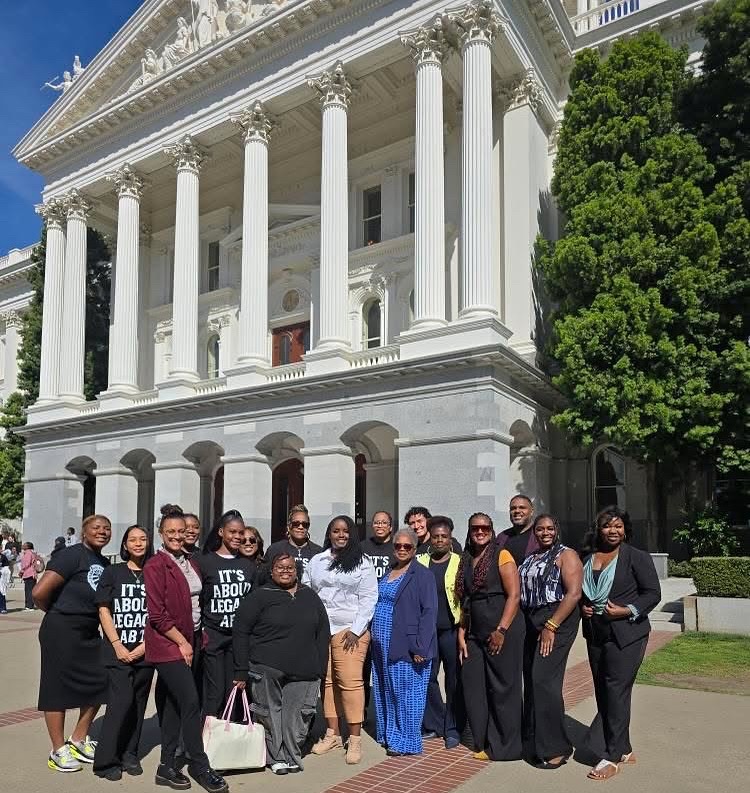
.The Alliance for Reparations, Reconciliation, and Truth (ARRT) is a coalition committed to advancing a comprehensive approach to reparations for Black Californians.
We bring together organizers, advocates, policy experts, and community leaders to move reparations from conversation to action grounded in truth, driven by community, and focused on lasting change.
We envision a California where the harms of the past are fully acknowledged and meaningfully repaired, where systems no longer reproduce inequity, and Black communities can thrive with dignity, health, and opportunity.
Reparations are not just about addressing what was done, they are about building what is possible.
ARRT works to educate, organize, and advocate for policies that advance reparations in California.
Through narrative change, public engagement, and policy advocacy, we are building the understanding and political will needed to achieve comprehensive, lasting repair.
ARRT advances reparations through:
The Alliance for Reparations, Reconciliation, and Truth (ARRT) emerged in response to a growing national demand for racial justice and a clear need to move beyond acknowledgment toward action.
Following the establishment of California’s Reparations Task Force through AB 3121, advocates, organizers, and policy leaders recognized that advancing reparations would require sustained public education, narrative alignment, and coordinated advocacy. ARRT was formed to meet that moment, serving as a bridge between research, policy, and community.
Since its founding, ARRT has worked to ensure that the momentum generated by the Task Force translates into meaningful, lasting change, grounded in truth, guided by community, and focused on repair.
The Alliance for Reparations, Reconciliation, and Truth (ARRT) is working diligently to inform Californians about, and build support for, its key positions and policy recommendations on historical injustice and racial equity.
Reparations should be impactful, transformative, long-lasting, and comprehensive, in accordance with the five United Nations principles for reparations.
Consistent with the UN principles, it is incomplete to limit reparations solely to financial compensation.
Consistent with AB 3121, reparations go beyond addressing harm from enslavement and must also redress ongoing racial pathology and legacy harms.
Reparations policies for Black Americans, particularly those focused on systemic reforms and investments, must have broad-based multiracial support.
The disparities we see today are the result of generations of policy decisions that excluded, extracted, and harmed Black communities.
Reparations are the pathway to address those harms through a coordinated, long-term commitment to repair what was broken and transform what still exists.
Interested in partnering, learning more, or taking action? Complete the contact form and connect with us.